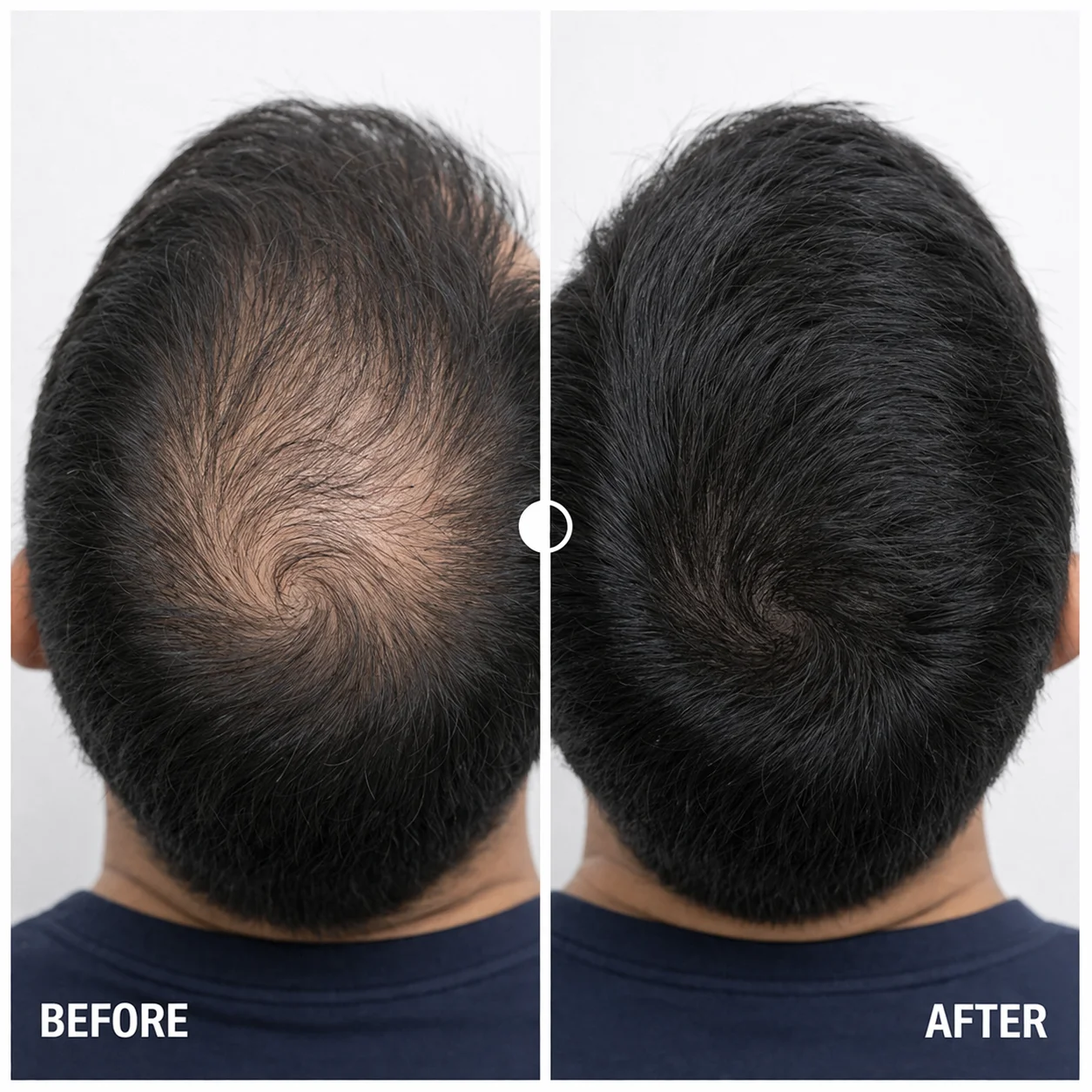
"How many grafts do I need?" is the first number every hair transplant patient wants. It decides how long the procedure takes, whether it can be done in one day, and what it costs.
The answer depends on three things: your Norwood stage, the area you want covered, and your donor hair. Here is how each one works, with the ranges Dr. Suhail Rather uses to plan transplants at Ixora.
Graft Chart by Norwood Stage
The Norwood scale grades male pattern hair loss from Stage 1 (a full hairline) to Stage 7 (hair mainly on the sides and back).
| Norwood stage | What it looks like | Hairline & temples only | Crown only | Hairline & crown |
|---|---|---|---|---|
| Stage 2 | Slight temple recession | 600–1,000 | 500–800 | 1,000–1,700 |
| Stage 3 | Deeper temples | 1,200–1,800 | 800–1,200 | 1,700–2,700 |
| Stage 3 Vertex | Deeper temples plus crown thinning | — | — | 2,200–3,200 |
| Stage 4 | Temples and crown thinning | 1,500–2,200 | 1,000–1,600 | 2,700–3,700 |
| Stage 5 | Larger crown, thin bridge | 2,000–2,600 | 1,500–2,200 | 3,700–4,700 |
| Stage 6 | Front and crown joined | 2,500–3,200 | 2,000–2,800 | 4,700–6,200 |
| Stage 7 | Hair mainly on the sides and back | 3,000–3,500 | 2,500–3,000 | 5,200–7,200 |
These are estimates. Your exact number is set at your consultation, after a scalp and donor examination.
Not sure which stage you are? See what Norwood stage is my hair loss?, or let the hair assessment work it out with you using pictures.
Why the Area Matters So Much
Look at Stage 4 in the chart: 1,500–2,200 grafts for the hairline, but 2,700–3,700 for the hairline and crown together. The crown is a large, round area, and hair there grows in a swirl, so it takes a lot of grafts to make it look full.
Many patients choose to restore the hairline first, because it frames the face and makes the biggest difference to how you look. The crown can be treated with GFC and medical therapy, or added in a second stage later.
How Your Donor Hair Changes the Number
Transplanted hair comes from the back and sides of your scalp, the donor area. Hair there is resistant to the hormone that causes pattern hair loss, which is why it stays after it is moved.
- Thick donor hair usually means a good supply, and the upper end of your range is possible.
- Thin donor hair limits how many grafts can be taken safely. For some patients the maximum is around 2,500 grafts, so the plan focuses on the hairline and protects the hair you have with GFC and medical treatment.
Your donor supply is finite. It has to last your whole life, including any second procedure, so a good surgeon never takes more than the area can spare.
Density: Why Some People Need the Upper End
If you want the fullest possible look rather than natural coverage, expect the upper end of your range, as long as your donor area can supply it. Sapphire FUE can help here: its finer channels let grafts sit closer together. See sapphire FUE vs standard FUE.
How Many Grafts Fit in One Day?
| Package | Grafts |
|---|---|
| Hairline Transplant | Fewer than 2,000 |
| Single-Day Transplant | Up to 4,000–4,500 |
| Double-Day Transplant | Up to 6,000–6,500 over two days |
| Staged Transplant | Two procedures, about 6–8 months apart |
So in practice:
- Norwood 2–4 usually fits in a single day.
- Norwood 5–6 usually needs two days, or two stages if your donor hair is thinner or you want maximum density.
- Norwood 7 is usually staged: coverage first, then density and hairline refinement once the donor area has healed.
Read more in single-day vs two-day vs staged hair transplant, and see the prices for each in our hair transplant cost guide.
What About Women?
Female pattern hair loss is graded on the Ludwig scale and thins the top and parting rather than the hairline. When a transplant is suitable, it is usually about 1,000–1,500 grafts at Stage II and 1,500–2,200 at Stage III. Read can women get a hair transplant?
Get Your Own Estimate
The free hair loss assessment asks about your stage, the area you want treated, your donor hair and your goals, then shows your estimated graft range and the package it fits. It takes about 2 minutes, and Dr. Suhail Rather confirms the number at your consultation.